Monday, May 14, 2012

Talking Poetry


It has been three weeks since my last update, which is overall unacceptable. I have quite a bit of content planned for the coming weeks, so this most recent hiccup will not be repeated for some time. Or so I hope.

In any case, today’s entry nods once again to the world of creative writing. My friend and colleague over at TrainWrite posted a short essay of mine several months ago that, though at the time I loved, I am now very much not a fan of. I expect a similar self-critical slide related to my second TrainWrite piece, which is a poem entitled “Hurricane.”

This post highlights form. Many poets write in a single pattern with rhyme, stress, or number of syllables coordinating the entire text. This works, and often results in exceptional poetry. Other poets don’t do this. George Herbert was one who tried to spice things up by playing with form. Perhaps his most famous example is “Easter Wings” (http://en.wikipedia.org/wiki/Concrete_poetry), where the shape of the text is related to the message found in the words (the stanzas look like wings…get it?).

Hurricane plays with form too, but not in the visual sense. Take the first two stanzas, for example:

THE CHAMP IS HERE!
He’s boarding the Braintree train at Harvard,
Neglected dreadlocks hanging almost jaggedly.
Hallelujah

MADISON SQUARE GARDEN. 1963.
His voice is mammoth,
it pops from his lips.
Hallelujah

There are clearly three “sections” in each stanza. There’s the part in all caps, two lines in normal font, then a line in italics. This can be a little confusing at first, but, really, poetry was made to be read over and over again. Anyone who understands the intricacies of this kind of text, even one written by an amateur poet such as myself, after one pass, is decidedly brilliant.

As you read through the poem, it becomes clear that the lines in all caps are being spoken by the main character in the story, “The Champ.” The middle two lines are from the narrator/bystander, and the last line is a song that was stuck in the author’s head while this whole thing went down.

That last part may or may not be an easy one to figure out. But that’s not really the point. What’s important to remember is that poetry, like all art, is something that can be played with and molded to fit what you think is best. Sure there are names for certain trends and techniques, like Herbert’s poem which some people very inventively call “Shape Poetry,” but each work is unique. Each work provides an opportunity to try something new. So what if it confuses the reader. Maybe that just means you’re an especially gifted poet!

Monday, March 26, 2012

Sifting Through Difficult Texts

I don’t think this is a topic that ever ceases to be a concern. No matter how much you read, how well-educated you are, or how much you think you know about the world, there will always be texts that are difficult to wade through. Often times when reading something difficult people begin to skim and just skip words or phrases they don’t understand altogether. This is a problem because these denser parts of text could (and often do) contain essential information.

Think about it. Let’s say you’re reading a lease agreement on a new apartment and you come to a passage you don’t completely understand. If you sign your name to that document, you could be authorizing the landlord to keep goats in the bathtub for all you know. That’s something to avoid.

In the spirit of helping you call keep goats out of your bathtub, I’ve come up with three guidelines to follow when reading difficult passages (or texts that are even longer!).

1. 1. Make the fuzzy crystal clear.

This is a personal peeve of mine. In a given context it’s pretty easy to understand what a certain phrase means. Often times, your gut reaction (if you’re a native speaker) is right on. But this isn’t always the case. English is a complex language and can therefore throw you for a loop every now and then. So keep on your toes.

Here’s an example of what I mean: Today I saw a mother get on the subway with her two kids. One was about 7 or 8, the other 10 or 11.

The smaller kid says to his mother: “Wow, after all that walking I’m hungry!”

Older brother exclaims: “He’s hungry again!”

Mother replies: “Well we have been walking a lot. He built up an appetite.”

Older brother notes: “Well, at least we made the train!”

Now I know what you’re thinking. You’re thinking “he’s just a kid, give him a break!” Yeah, this is true. But the kid said “At least we made train.” There’s no counter point wherein making the train causes the situation to require a silver lining. His parents are probably to blame for not explaining the finer points of the phrase "at least." But I digress.

I don’t bring this up to be fussy or to make the kid feel bad (sorry, kid). I bring it up to provide an example of what can happen if people take what they think something means, and run on without making sure. When I read, if I come across a word or phrase that I’m not sure about, I check my gut by looking in the dictionary. It makes a difference.

The dictionary method works with words you have no idea about, too, by the way. I recommend it because this is not a difficult step to take, and it ensures that you’re not ill-informed or the subject of a Laundromat blog post. Plus, if your lease reads "The bathtub shall at all times house Capra aegagrus hircus" it would be a good idea to double-check what the crazy Latin is referring to. And, no, it doesn't mean "shower curtain."

2. 2. Keep a Journal

One thing that I love to do, but honestly have a little trouble keeping up with, is keeping a word and phrase journal. I used to tell my ELL students to do this, and it worked out nicely because we got to spend the first fifteen or so minutes of each class clarifying and talking about funny quirks in the English language. It helped them very much, and opened my eyes to a lot of absurdities as well.

Since English is so complicated, the crazy words don’t stop once you’re fluent. Try keeping a list of cool, tough, random, or funny words and their definitions (and maybe a sample sentence using it), and reference that list when you write. It’ll make you sound snazzy, but also drill in phrases you're naturally unsure about, thus helping you keep the goats out of your bathtub.

3. 3. Go Slow and Write a Summary

Taking your time is essential when reading a legal document, a French philosopher, Kenneth Burke, and maybe even an email from your Uncle Mortimore. If you go too fast, you will miss things. To avoid this, try taking your time, circling words you don’t understand, and keeping track of their definitions. Then, at the end of each paragraph (or sentence if need be), try writing a summary of what you just read in plain language. That way you won’t have to return to the piece later and decode it all over again. This is especially handy if you’re a student and you don’t want to lose those reading epiphanies you had while doing your homework.

Sadly, I don't have a goat joke for this one.

I hope these suggestions are helpful. What strategies do you use when reading a difficult text?

Also, what kind of topics would you like the Laundromat to cover in the future?

Tuesday, March 6, 2012

Writing a Novel

I recently finished reading a novel for someone who is hoping to whip the pages in to publishable condition. While I don’t often write about fiction here, I thought I’d offer a little advice for those of you who have a rough manuscript or outline sitting in your desk drawer. There is a lot to writing a novel, so please don’t expect this to be the seminal “How To” work on novel writing. The following, however, should be enough to get you started.

The Truth

Writing a novel is difficult: Anyone who’s ever been to a garage sale has seen dozens of really bad novels piled in a corner, the owner of which are desperate to get the things out of their home to free up space. But just because the world is overflowing with poorly written books (and extremely well-written ones, for that matter), publishing a novel is still difficult. In fact, most of those grocery store numbers you see with Fabio on the cover weren’t written by a shoe salesman from Nashua who always wanted to write a book. No, they’re usually written by a team of people whose job it is to crank those babies out. In many cases, the author is little more than a brand, and the book itself is akin to your Nikes (put together by a bunch of different people who are often underpaid for their work).
You’ve usually got to know somebody. Or have an agent: Because there are teams of people writing books like it’s their job (well…okay, it actually is their job), the market is pretty well saturated, so it’s tough to get in. But not impossible. There’s a book you can get at most any major library called The Writer’s Market. It’s published every year and lists just about every publishing house in the country – large or small – and provides a brief description of what kind of books each publisher is looking to work on over the coming year or two. It will also tell you whether or not the publisher is willing to accept an unsolicited manuscript from the shoe salesman in Nashua. It’s probably 50/50 as to whether or not a publisher will accept unsolicited manuscripts, but a whole other conversation as to whether or it will end up anywhere but the trash can. Here’s a tip, though: smaller publishers will typically read each submission, so don’t send your firs work off to Penguin because that’s a waste of 44 cents if you get my meaning.
You need to know how to write: I’ve met a lot of people who have great stories to tell. But I’ve also read manuscripts from those individuals that are confusing, poorly organized, and generally not entertaining. Writing well takes practice. Even if you got an A in English 101 and your prof loved your work, it’s a good bet you’re not ready to take on a novel. Writing takes a lot of work and time, but it also requires developing of a skill. Being a “good writer” is no easy thing. The following section provides a few tips on this – but be prepared to put the work in. Or, if you’re really impatient, find a friend who is a good writer, and ask them to co-write or ghostwrite the thing.

How do I make this pile of paper in to a good book?

Organize: The most annoying thing to me is reading a story that has clearly not been thoughtfully organized. Just as you would be told to write an outline for an essay, do this for your novel in order to get a macro view of whether or not the flow of the story makes sense and represents a natural progression.
Read: Another great idea is to steal ideas from– I mean read – books that are similar to the one you want to write. Look at the way chapters are organized. For example, do they jump from one character’s perspective to another? Do they jump timeslines? Do they provide much background knowledge on the fictional society you’re inventing? Certainly don’t copy another author’s work, but you can adapt, adjust, or just get your brainstorming jumpstarted by reading an accomplished writer’s work.
Do Research: To provide vivid details or to incorporate believable dialogue, do some research. There’s nothing worse than a book that doesn’t paint a picture in your head, or features page after page of dialogue that makes the character feel like a character from Family Matters or Step By Step. This means eavesdropping in the coffee shop for a while, or if you’re writing a passage on someone who is running through the woods, lace up the sneakers and take a jog. Imagine your novel describing “John’s footballs dully tapping the dirt trail, and the newly arrived Spring sun warming his face as he closed his eyes and felt his body glide through the wood” as opposed to “It was April and John ran in the woods.” Details and avoiding vague language make a big difference. Research is the way to make your details sound natural. (Just don’t go jumping off the top of a building or something in the name of art, okay?)

As I mentioned above, writing a novel is great, but it also takes a lot of work. The tips mentioned above are by no means a complete guide to novel writing, but it’s my hope that they can help you get started. Once you get in to the writing, planning, and researching groove, you’ll come up with some tricks that work for you specifically. But rest assured, there are a few things you can do to get past the initial terror of wondering how to begin.

Happy writing!

Monday, January 16, 2012

Misused Words and Unintended Meaning

For some people the greatest challenge to becoming a good writer is avoiding common, conversational phrases that have been warped over the years to the point that most people misuse them. Because every word must serve a specific purpose for the writer, misusing phrases can cause serious problems whether it be damaging his credibility or confusing the reader.

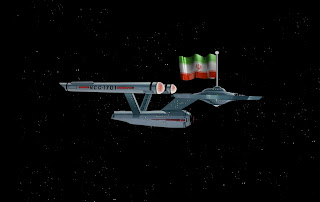
The same is true in speech. Take Rick Perry as an example. On January 7th Perry took part in the New Hampshire Presidential Primary Debate and explained that he is in favor of maintaining a significant presence in Iraq because once American troops leave Iran will move in "literally at the speed of light."

"Literally" is one of the most often misused words these days, and it signals that a given fact is not the product of
exaggeration, but a true reflection of reality. In Perry's case, he seems to be suggesting that Mister Scott has been hard at work prepping the Starship Enterprise for a trip to Baghdad.
Regardless of your political stance, a simple mistake like this one serves to hurt his reputation, and perhaps even suggest he lacks the necessary intelligence to serve as President of the United States. All this because of one word.

To help you avoid any Perry-like mistake I've compiled a list of misused words and their corresponding correct uses (or replacements) as well as a few common phrases that communicate something very different than what is intended.

Alot vs a lot -
This is a troublesome because a "lot" is actually a unit of measure. It has, however, largely been accepted as meaning "a significant number," but it is important to remember that the correct spelling consists of two words: a lot.

"I looked at him for a minute, then said 'I think it's time to go.'" -
What this is supposed to mean is "I looked at him for a few seconds." Remember, words have specific meaning and something that may be seen as common in conversation may not translate correctly in to writing. Imagine someone staring at you a a full 60 seconds without saying a word. "I looked at him for a minute" takes on a whole new meaning.

"I knew there were a ton of topics we had to discuss" -
A ton is equivalent to 2000 pounds. This is a problem because it can be misleading ("I have a ton of apples here!"), but as in the case listed above, it just plain doesn't make sense that he had "a ton of topics to discuss" because a "topic" doesn't weigh anything.

Capacious vs. Capricious -
These are two words that are often confused, if not misused, because they look and sound very similarly. The first means "having great capacity to hold something," while the second means: "one who has a tendency of giving in to whims." As you can imagine, confusing these terms could cause problems.

"Lo! and behold" vs. "Low and behold"
This one is my personal favorite. People don't say "Lo!" much these days, which explains why many write "low" instead. But if you think about the meaning of this phrase (which I translate roughly as "Hey! Take a look at this!") the word "low" has no place at all. The word "Lo!" however is an exclamation used to draw attention to something, while "behold" means "take a look."

The Death Star is now ultimate power in the universe -
Much like "a ton," an incorrect definition of "ultimate" has been widely accepted. Most people (including the writers for Star Wars) use it describe something that is "the best" or "most powerful." However, the word actually means "the last" of something. For instance it would be correct to say "The 7th season of Gilmore Girls was the ultimate season" because there were only seven seasons produced.

Towards and Anyways should not contain an "s" -
I'm not really sure how these mistakes came in to being, but a great many people place an "s" at the end of both "toward" and "anyway."

I hope these suggestions help you become a more informed writer and speaker. What kind of misused words have you heard or read?

Saturday, January 7, 2012

Tailoring a Resume: Part 1

In what is sure to be the first of many installments, this post will explore a few ways of tailoring a resume to a specific job. Writing a resume to fit a given job will do wonders in helping you reach the interview stage of the hiring process. Indeed, one of the worst things a person can do it submit a resume that isn't designed with the job in question in mind.

The best place to begin is the job description and position requirements. The following job description has been placed next to a general (though not necessarily complete) resume. Try to identify key qualifications on the job description, and where they could be placed in the resume. (Click on the image to enlarge).


Usually an applicant won't meet each and every qualification listed. For instance, in this case the announcement calls for an applicant to have four years experience in a similar position. However, he does have an advanced degree, which the announcement does not call for, and he does have over one year of experience in a position that is directly related. In this case, the key is to meet or exceed as many of the qualifications as is possible.

Additionally, the positions the applicant has held each have some connection to the job description and requirements. Without stating this directly, though, the person reading the resume will have no way of knowing this! Take a look at the following examples where key requirements have been circled, and key resume additions have been highlighted. (Click on the image to enlarge).
The sections circled in red represent qualifications the applicant can touch on, and more beefed up version of the resume is on the right, with particularly useful additions highlighted in yellow.

Some of the notes made on each entry would not be necessary or appropriate for certain jobs, such as experience with financial management software, or serving as the company's main contact with an outside entity. These do, however, relate to central tasks of the would-be employee. It is precisely because having experience with something like financial management software is essential to this position and not necessarily others that a general resume should never be submitted when applying for a job.

More tailoring suggestions to come!

The Laundromat Writer


Saturday, December 31, 2011

Welcome!

This blog was created as a free resource to help people learn writing and editing skills. No matter the topic or medium, we can help!

If there is a topic you'd like this blog to discuss, please go let us know through the "Contact" page or by commenting on a blog post.

If you have a project you'd like us to help you clean up, you can also visit the "Contact" page to learn more about our specific services and rates.

Thanks for visiting!

Best,

The Laundromat Writer